
To improve the safety of your homes, offices or warehouses, buying a CCTV system is not enough for better surveillance; the installation plays a key role in it. There are different types of CCTV cameras in the market, known for many reasons and features. Some are ideal for indoor surveillance, and some are very good for outdoor surveillance. But it works only ideally when the installation is perfect. Because common CCTV installation mistakes can ruin all of your investment to protect you from theft and burglars. These mistakes are different and so common, like faulty wiring or infrequent maintenance. If you plan to install or upgrade a CCTV system in Orange County, then you need to make sure you are aware of all the details of proper installation and avoid mistakes, and this blog will be very helpful to avoid and understand all the common CCTV Installation Mistakes.
Buying Wrong Types of Cameras
When installing CCTV systems, people often make the mistake of not thinking of the types of cameras they buy. Domes, bullets, turret, pan-tilting-zoom, as well as IP security, are designed for different purposes. For example, in terms of outdoor security, you may want to invest in cameras that stand extreme weather conditions, while for indoor surveillance you may consider dome cameras that are not visible to anyone.
Installing Cameras in the Wrong Position
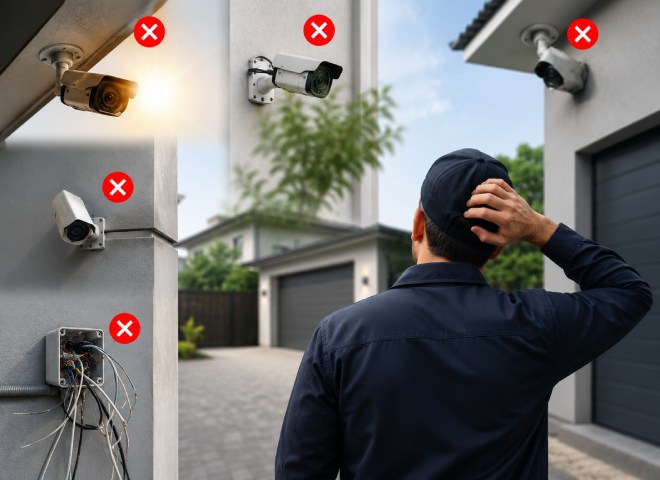
Despite being high-quality, a CCTV camera won’t provide the level of security that it should need to be. When looking to benefit from video surveillance, it is important that cameras are installed at useful points to see all the locations clearly, like car parking areas, entrances, corridors, doors, etc. It is important to avoid locations where cameras could be placed too high, too low, or behind an object blocking vision. Proper positioning of cameras will help eliminate blind spots and increase usefulness of video surveillance.
Overlooking Light Conditions
The significance of light in the quality of the image has to be considered. If the surveillance camera is set up in an environment with strong sunrays, backlight, or black, then the recording will not be efficient. For night observations, it is suggested to get good night-vision cameras instead. One should test cameras during the daytime and before operating them at night.
Poor-Quality Cables and Connections
Using bad quality cables, connectors, or power supplies is also a common mistake, just for saving a few Dollars. Bad wiring may produce lack of signals, cause instability of connections, initial cost or lead to downtime of the camera. Professionals in CCTV installation always use needed cables and reliable connections for the camera system. Proper cabling also protects wires from being damaged.
Forgetting Network and Cybersecurity
Modern IP cameras rely heavily on networks that make cybersecurity a significant factor in the installation of CCTV. Leaving passwords and usernames unchanged for a longer period, employing weak personal passwords, and failing to install camera firmware updates leave one with security holes. Utilize proper login information, secure your wired or Wi-Fi connections, and continually upgrade the system during the period.
Choosing Insufficient Storage
A surveillance system will only function correctly when it has enough memory space to keep the recorded footage for more days that can be determined. If you choose an NVR or DVR with insufficient capacity. Then you will lose all the important data in quick time. The number of cameras, video quality, recording period, and memory requirements are factors you need to understand well before CCTV installation in Orange County.
Neglecting Regular Maintenance
Timely maintenance is necessary for the CCTV system to work effectively. Dust and dirt, external factors, poor connections, old software, and defective cables affect the operation of CCTV systems negatively. Maintenance of CCTV includes cleaning of cameras, carrying out the tests regarding the connections, checking the video quality and updating the software when necessary.
Essential CCTV Installation Tips
- Choose the Type of Camera: The type of camera depends on the selected site, lighting, distance, and level of security needed. Different cameras like dome, bullet, turret, PTZ, or IP cameras are used for different cases.
- Location for Cameras: Install cameras in vulnerable areas in the building, including entrances and exits, parking grounds, corridors, etc. Avoid locations that limit the cameras’ view.
- Consider Lighting Conditions: Test the camera’s ability in both bright and dark conditions. Installing infrared or low-light cameras would help in areas where the light is insufficient.
- Right Types of Wiring: Quality cables, connectors, and power sources must be used for installation. Using good-quality wires is necessary to avoid losing signals as well as having various connection issues.
- Safety Of Network: Replace the passwords frequently, and build strong passwords and keep the network well-secure.
- Right Storage: The number of cameras, video quality, recording length, and storage requirements need a system that can store more videos.
- Verify Camera Positioning: Check for camera positioning after installation. Check if the angles of the cameras cover all important spots and unnecessary areas do not take the majority of the frame.
- Test Night Vision: Verify the night vision and infrared features of the cameras prior to finalizing the setup. Clear footage obtained at night is essential for continuous monitoring purposes.
- Activate Remote Monitoring: Allow for secure remote access for those who have the permission to access the CCTV system remotely.
- Regular Maintenance: Make sure that the CCTV system stays in check by cleaning the camera lens and checking its wires regularly.
Conclusion
Avoiding the common mistakes when installing CCTV systems can greatly improve the reliability of the systems. Proper selection and placement of cameras, appropriate wiring and configuration of the network, sufficient storage capacity, and professional installation improve the security for business owners and property owners. We recommend all the homes and business owners in Orange County to install all the cameras through a professional team, and no one can do it in a better way than the FDS Orange County.